Retail EDI Integration and Automation
This project implemented EDI integration with a new retail partner to enable automated and reliable electronic document exchange between the retailer, supplier ERP system, and warehouse management system.
The integration supported the end-to-end order lifecycle, including purchase order processing, inventory visibility, warehouse fulfillment, shipment notification, and invoicing through standardized EDI transactions.
Electronic Data Interchange is a critical component of modern trading and e-commerce operations. It allows trading partners to exchange business documents electronically in standardized formats, eliminating manual data entry and improving transaction speed, accuracy, and operational efficiency.
For high-volume retail and e-commerce channels, EDI supports automated order processing, real-time inventory visibility, faster warehouse fulfillment, accurate shipment notifications, and automated invoice transmission. In omnichannel retail environments, EDI provides scalable system-to-system communication that reduces manual errors, improves service levels, and supports retailer compliance requirements.
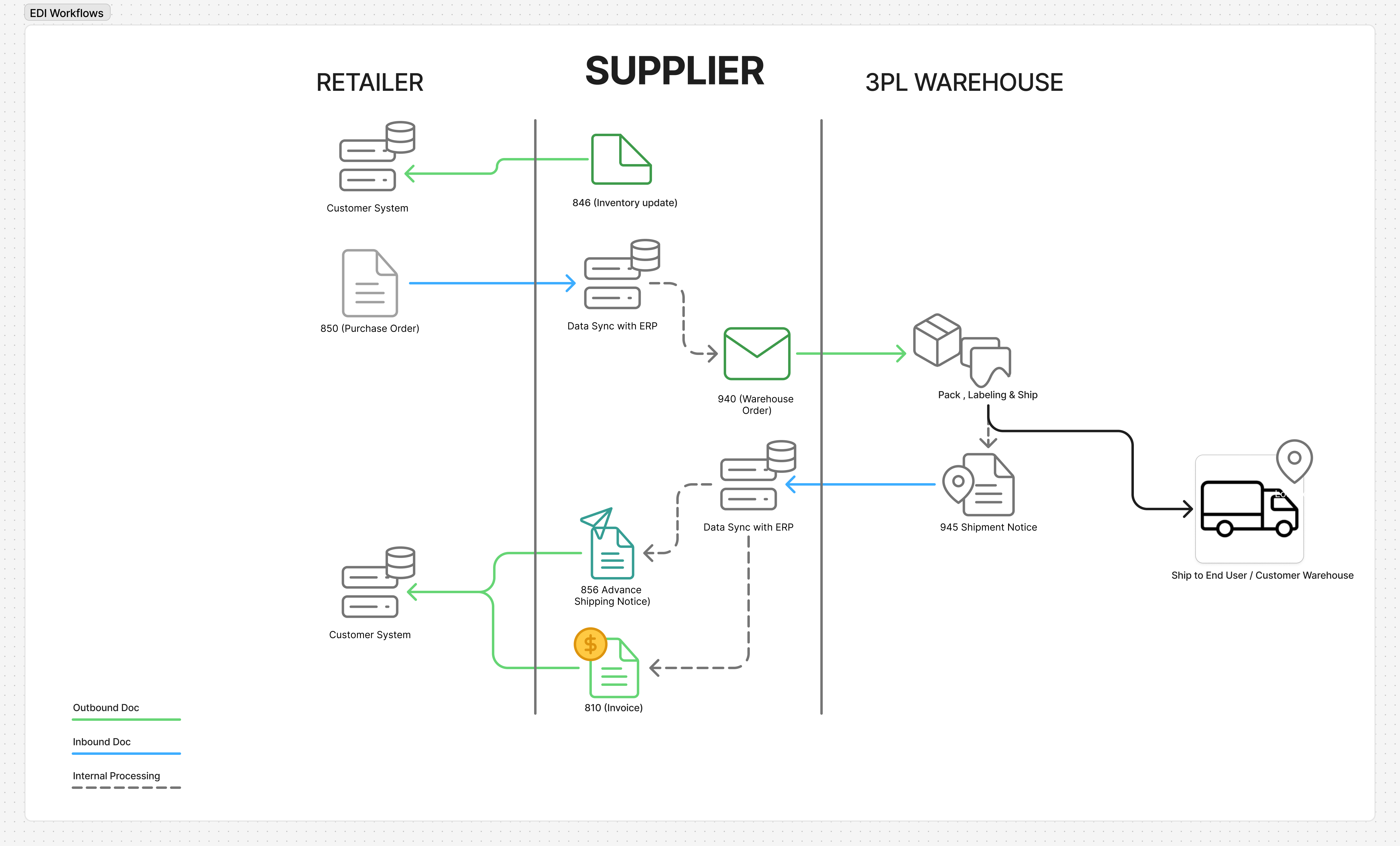 EDI Workflow
Retailer → Supplier → Warehouse → Supplier → Retailer
- Supplier sends 846 Inventory Advice when required.
- Retailer sends 850 Purchase Order.
- Supplier sends 855 Purchase Order Acknowledgment.
- Supplier converts order details into 940 Warehouse Shipping Order for the 3PL warehouse.
- Warehouse processes picking, labeling, and shipping.
- Warehouse sends 945 Warehouse Shipping Advice after the product is shipped.
- Supplier generates and sends 856 Advance Ship Notice with tracking information.
- Supplier sends 810 Invoice to the retailer.
Planning → Mapping & Development → Testing → Deployment → Maintenance
- Planning: Define project requirements with the retailer and internal stakeholders; confirm document standards, mandatory fields, packing standards, label requirements, and business rules; define the integration architecture between the EDI platform, ERP, and WMS.
- Mapping & Development: Configure EDI mappings for 850, 860, 997, 846, 855, 856, 810, 940, and 945; develop AS2 or SFTP connectivity with the retailer; integrate supplier ERP and warehouse management systems; configure packing list and shipping label templates.
- Testing: Complete EDI connectivity testing, document mapping validation, unit testing, warehouse integration testing, and end-to-end order flow/UAT.
- Deployment: Prepare the production cutover plan, execute go-live migration, monitor initial transactions, and resolve post-go-live issues.